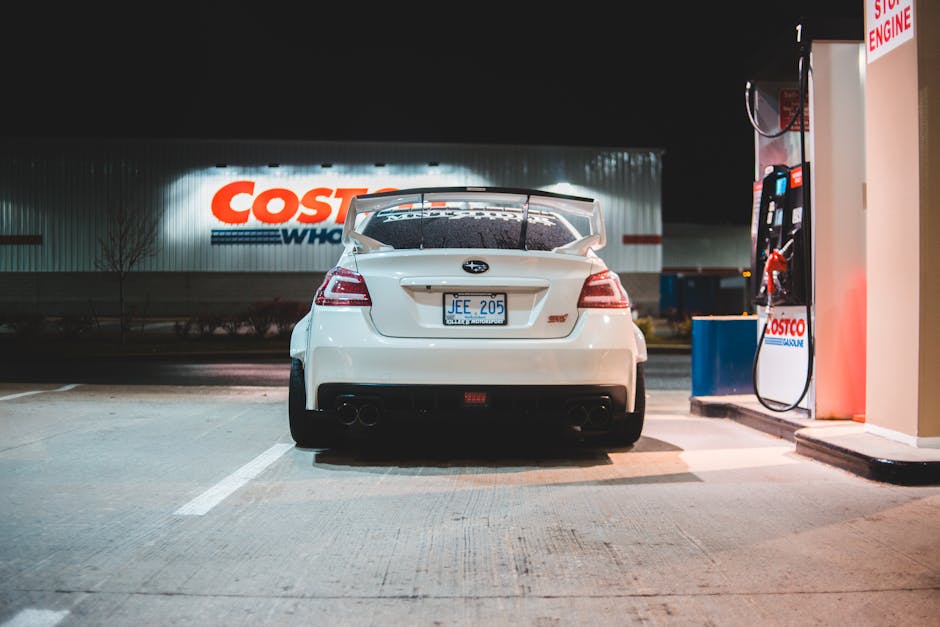
The Real Reason You Wait in Line for Costco Gas
It's 8:47 AM on a June Saturday in Bellevue, Washington. The Costco gas station already has 22 cars in each of its six lanes. Everyone has accepted a 12-minute wait for what amounts to about $4.50 of savings.
That arithmetic—12 minutes of your life for $4.50—is the most misunderstood calculation in retail. Analysts love to call Costco gas a "loss leader." They're half right and half dangerously wrong.
The standard story: Costco sells gas at near-zero margins to get you inside, where you'll buy a $50 rotisserie chicken and a $1.50 hot dog. That story is true, but it misses the deeper mechanism.
Here's what actually happens. Gas is priced at 9 to 15 cents under the nearest competitor, depending on the market. In Los Angeles this week, the gap is 14 cents. In Phoenix, 11 cents. That gap is carefully calibrated—not to maximize profit, but to maximize cognitive load.
Because once you've decided to save that $4.50, you've already conceded that Costco is worth a detour. You've made a small commitment. And commitment, as every behavioral economist since Cialdini has shown, scales. You're now primed to buy more.
But the real twist is this: the wait itself is the product. Costco deliberately underbuilds pump capacity. They could install double the pumps. They don't.
The line is a signal. It tells every passing driver: something valuable is happening here. And once you're in the line, sunk cost locks you in. After three minutes of waiting, you're not leaving for a 12-cent difference down the street.
All of this is conventional wisdom among retail analysts. But there's a layer below that almost nobody discusses.
Costco gas stations are cash machines in a different sense. According to Costco's 2025 10-K filing, gasoline generated $38.7 billion in revenue last year—about 12% of total sales. But the gross margin on that fuel was just 1.3%. That's roughly $500 million in profit before operating costs.
Now here's the part that breaks the standard model. That 1.3% margin isn't actually the point. The real profit center is the credit card float.
Costco's co-branded Visa card carries a 19.99% APR. When you buy gas with that card, Costco gets paid by Visa within 48 hours. You take 30 days to pay your bill. That 28-day float on $38.7 billion at 5% interest (what Costco earns on its cash reserves) is roughly $150 million annually. It's free money generated by gas purchases.
The counterargument is obvious: if gas is such a draw, why don't competitors copy the model? Some do. Sam's Club offers similar pricing. But here's where Costco's structural advantage kicks in.
Costco owns its gas stations. Sam's Club leases many of theirs from Walmart's real estate arm. Owned infrastructure means Costco depreciates pumps over 20 years. Leased infrastructure means Sam's Club writes off the cost in 7. That 13-year difference in depreciation schedule makes Costco's per-gallon cost about 2 cents lower. In a business where margins are measured in pennies, that's a fortress.
None of this explains the most curious behavior: why people fill up at Costco when they don't need to. I watched a woman last week in Seattle put exactly 3.7 gallons into a Toyota Highlander that already had a half tank. She was optimizing for convenience on a future trip, she told me. But the math doesn't work.
Half a tank of Costco gas saved her roughly $1.75. She waited 8 minutes. That's $13 an hour for her time. She makes $85,000 a year managing a dental practice.
The cognitive bias at play is the "endowment effect" applied to discount-seeking. Once you've decided Costco gas is worth it, every tank becomes an excuse to reaffirm that decision. You're not saving money. You're validating your identity as a savvy shopper.
Look at the demographics. Costco's average member household income is $125,000. These are not people who need to save $4.50 on a fill-up. They're people who derive psychological utility from the act of saving.
This is where the conventional line-waiting critique falls apart. Critics say Costco should just raise gas prices and eliminate the wait. They're missing the point. The wait IS the value proposition. It's a ritual that confirms membership is worth it.
So what happens next? Three trends are converging.
First, electric vehicles. EV adoption in the US hit 12.4% of new car sales in April 2026. Every EV driver is a lost gas customer. Costco is responding by installing charging stations at 140 locations, but the economics are different. Level 3 chargers cost $120,000 each. A gas pump costs $20,000. And EV charging takes 30 minutes minimum—completely incompatible with the 12-minute line model.
Second, the Kroger-Albertsons merger is reshaping grocery competition. If that merger closes (it's pending litigation), Kroger will have the scale to match Costco's gas pricing in key markets. That 11-cent gap in Phoenix could disappear.
Third, and most interesting: refinery capacity. The US has lost 1.2 million barrels per day of refining capacity since 2020. When refineries tighten, wholesale prices diverge. Costco's ability to hedge fuel purchases (they own a trading desk in Houston) gives them a 1-2 cent advantage that most competitors can't match. That advantage grows when refineries are constrained.
Watch for Costco to acquire a refinery. It sounds absurd. But in 2024, their CFO said on an earnings call that "we're evaluating all options to secure supply." That's the language of a company that realizes its competitive moat in gas is being eroded by physics, not competition.
If Costco buys a refinery—say, one of the Pasadena refineries that's been on the market—they'd control the entire vertical chain. That would let them drop prices another 5 cents and still maintain margins. It would also make them a fuel wholesaler to other retailers, fundamentally changing the dynamics of the US gas market.
The endgame: gas as a permanent loss leader, subsidized by membership fees and credit card float, but now also subsidized by refinery margins. You'll wait in line for a decade more. And you'll feel smart doing it.
That feeling—the satisfaction of the hunt—is the only product Costco actually sells. The gas is just the bait.
💬 Comments