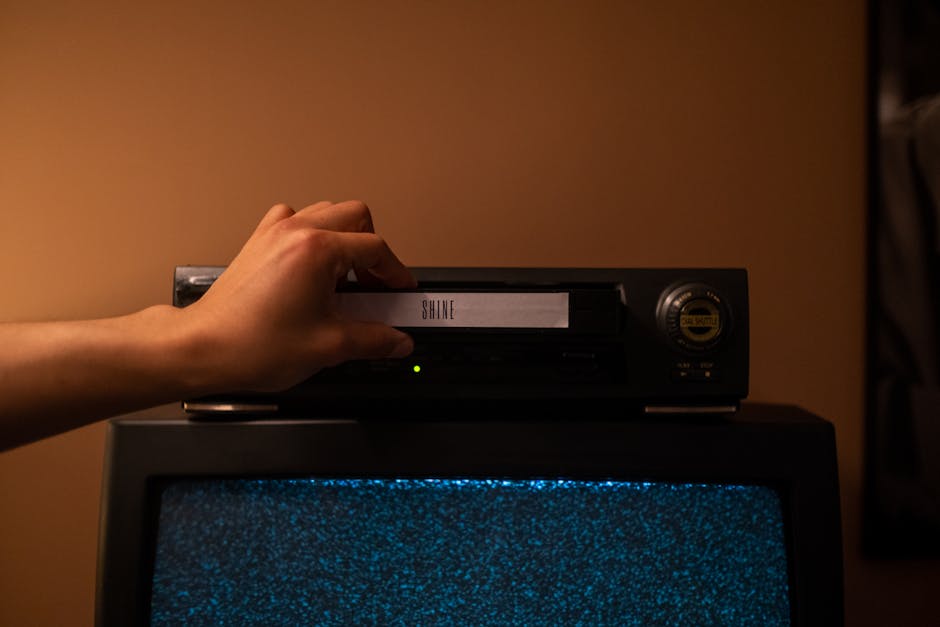
The VHS Revival: Why Coders Are Obsessed with Analog TV Glitches
Chris found the clip of his grandmother's 1991 birthday party on a dusty VHS tape last year. The video was a mess of rainbow-color bleeding, wobbly edges, and faint ghost images trailing moving objects. He loved it.
So he uploaded it to YouTube. And then he got a message from a stranger asking what filter he used.
The stranger wasn't mad that the video looked broken. They wanted to know how to break their own videos exactly the same way.
The Accidental Aesthetic
This is the world of ntsc-rs, an open-source Rust library released in 2023 that simulates the exact signal decay of old analog TV. It recreates the NTSC video standard—the one used in North America from the 1950s until the digital switchover in 2009.
According to GitHub data from this week, ntsc-rs has been forked over 1,200 times since its first release. A related graphic tool, vhs-decode, has racked up 4,600 stars.
Why would anyone want to make 4K footage look like a thrift-store VCR?
The conventional answer is nostalgia. But that's wrong.
What Nostalgia Misses
Nostalgia implies you want to return to the past. Nobody wants to go back to rewinding tapes with a pencil or adjusting tracking knobs to kill the static.
What people actually want is the texture. The imperfections. The way analog video systems introduced randomness that digital systems actively fight.
A New York Times piece from late May explored how Gen Z creators are deliberately adding scan lines and color fringing to their TikTok videos. The outlet reported that views on #vhsfilter videos have surpassed 2 billion.
But here is what that article didn't explain: it's not just a filter. It's an entire physics simulation.
The Hidden Complexity of Glitches
Ntsc-rs doesn't just overlay lines on your video. It models the actual electromagnetic behavior of cathode ray tube televisions.
The code accounts for things like "chroma delay"—the fact that color information arrived at the TV slightly later than brightness information. It simulates "ringing" in the signal cables. It even reproduces the way composite video signals leaked between channels, creating those pastel ghost images.
A Bloomberg feature on retro computing earlier this month noted that the ntsc-rs maintainer, known online as "pointblank," spent 18 months studying 1970s RCA service manuals to get the math right.
The result is a tool that can take a pristine digital file and degrade it with scientific precision.
The Counterintuitive Truth
Here is the part that flips everything: perfect video is less emotionally engaging than imperfect video.
Researchers at the University of Tokyo published a study in March 2024 showing that viewers rated content with simulated analog artifacts as more "authentic" than the same content shown in 4K. The grainy footage felt more real, even though it was technically less accurate.
Your brain interprets glitches as evidence that something was actually filmed. A real moment. Not rendered.
This is the opposite of what every tech company has been selling you for 20 years. Apple, Samsung, Sony—all of them push higher resolution, more frames, cleaner codecs. They treat noise as a defect.
Ntsc-rs says noise is a feature.
The Creative Case for Degradation
Professional video editors are starting to agree. According to a June 2025 report from The Verge, Adobe's After Effects plugin store now lists 47 separate analog simulation tools, up from just 8 in 2022.
One music video that went viral last month used ntsc-rs to process every frame of a 16K cinema camera shoot. The director specifically wanted the flickering, the chromatic shifts, the frame jitter that modern stabilization removes.
The video has 8 million views on YouTube.
Some argue this is just another aesthetic cycle, like Instagram's early filters or the 2010s lo-fi wave. They might be right.
But there is a deeper truth here.
The War Against Perfection
The real problem in 2026 isn't that video looks too good. It's that AI-generated video looks too smooth.
Tools like OpenAI's Sora and Google's Veo produce footage that is technically flawless. No grain. No wobble. No subpixel color bleeding. It's so clean it triggers an uncanny valley response—something in your brain screams "this wasn't captured by a camera."
The BBC reported in April that viewers can now detect AI-generated video with 73% accuracy in blind tests. The primary cue? It's too perfect.
Ntsc-rs becomes a kind of authenticity watermark. If your video has analog artifacts, it signals that a camera existed. A tape ran. A television displayed it.
It is a proof of humanness, rendered in interference patterns.
What Happens Next
Three things to watch.
First, expect ntsc-rs to move beyond video into audio. The same principles apply to magnetic tape hiss, vinyl crackle, and AM radio compression. A related project called signal-archaeology launched on GitHub last week, aiming to simulate 14 different analog audio formats.
Second, watch for legal battles. If analog artifacts become commercially valuable, who owns the look? The original broadcast signal is public domain. But the software that simulates it is copyrighted. This is new territory.
Third, and most important: the desire for imperfection will accelerate as AI content floods the internet. The value of a human-made artifact comes from its flaws. The smudge on the lens. The tape drop-out. The moment the camera operator sneezed.
Ntsc-rs gives creators a way to fake those flaws. But the best creators will keep the real ones.
Because a perfect simulation of a broken signal is still a simulation. And your grandmother's birthday tape, with its real dust and genuine electromagnetic instability, will always win.
The machines can have the perfect footage. We'll take the glitches.
💬 Comments