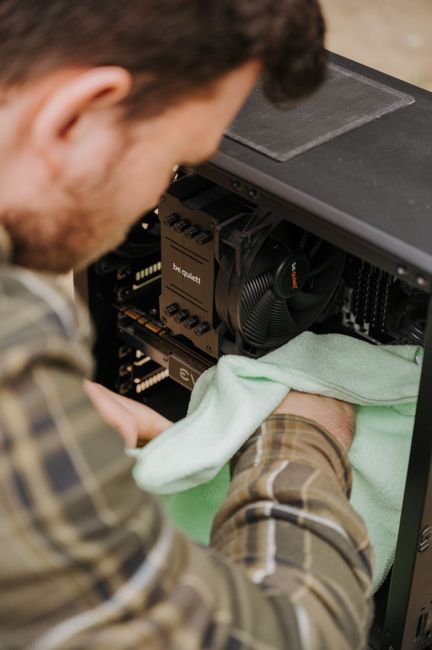
I Love My Computer More Than Your Phone
Here is something most people get wrong: the personal computer is dying.
Every tech analyst has been saying it for years. Smartphones rule. Tablets are the future. The PC is a relic from the dial-up era.
I call bullshit.
Right now, I'm typing this on a five-year-old ThinkPad with a cracked trackpad and a keyboard so grimy the W key is almost invisible. I love this machine. It's not cute. It's not sleek. It does exactly what I need it to do.
The numbers back me up. According to IDC's latest report from May 2026, global PC shipments actually grew 4% year-over-year in Q1 2026. That's not a dying market. That's a stubborn, grinding comeback.
Meanwhile, smartphone sales have flatlined for three straight quarters. Apple just reported its worst iPhone quarter since 2023. The Financial Times noted this week that consumers are holding onto their phones for an average of 4.2 years now.
The conventional wisdom is that everyone wants everything on a tiny glass slab. The reality is that real work demands a real machine.
Think about what you actually do on a phone. You scroll. You swipe. You reply to texts with your thumbs. Now think about what you do on a computer. You write reports. You edit spreadsheets. You code. You design. You compose.
One is consumption. The other is creation.
Here's the twist: the pandemic broke the spell. When millions of people were forced to work from home in 2020, they rediscovered what a proper computer can do. A Bloomberg analysis from 2021 showed PC sales surged 13% that year — the biggest jump in a decade.
That momentum didn't vanish when offices reopened. It just changed shape.
People bought better machines. They invested in monitors, mechanical keyboards, proper mice. The Wall Street Journal reported in 2025 that the PC accessories market hit $12 billion for the first time.
We are in a golden age of the desk setup. It's not just for gamers anymore.
The irony is that phones are getting worse at being computers. App bloat is out of control. Storage fills up in months. Battery life degrades in two years. And don't get me started on planned obsolescence — your iPhone 16 will be obsolete the moment the 17 drops.
My ThinkPad? I've upgraded the RAM twice. Swapped the hard drive. Replaced the battery for $40. It runs Linux like a champ.
You can't do that to a phone. You're not meant to.
The industry wants you to believe that a $1,000 phone is a computer. It's not. It's a portal to a walled garden where Apple and Google control every gate.
A real computer is open. It bends to your will. It's not a consumption device wrapped in a subscription.
I'm not saying phones are useless. They're incredible — for calls, maps, photos, quick searches. But they are not computers. They are the digital equivalent of a vending machine.
Here's what this means for you: if you feel guilty about how much time you spend on a proper desktop or laptop, stop. You're not a dinosaur. You're someone who actually wants to build, write, or make something.
The next trend to watch is the rise of the mini-PC. Intel's NUC line, Framework's modular laptops, and the resurgence of small-form-factor desktops are all signs that people want control back. A Reuters report from March noted that Framework's revenue doubled again last year.
Smaller, cheaper, more repairable. That's the future of the computer.
I love my computer because it asks nothing of me except that I use it. No notifications. No app store. No endless updates that break everything. Just a cursor blinking, waiting for me to do something.
That freedom is rare now. And it's worth defending.
💬 Comments