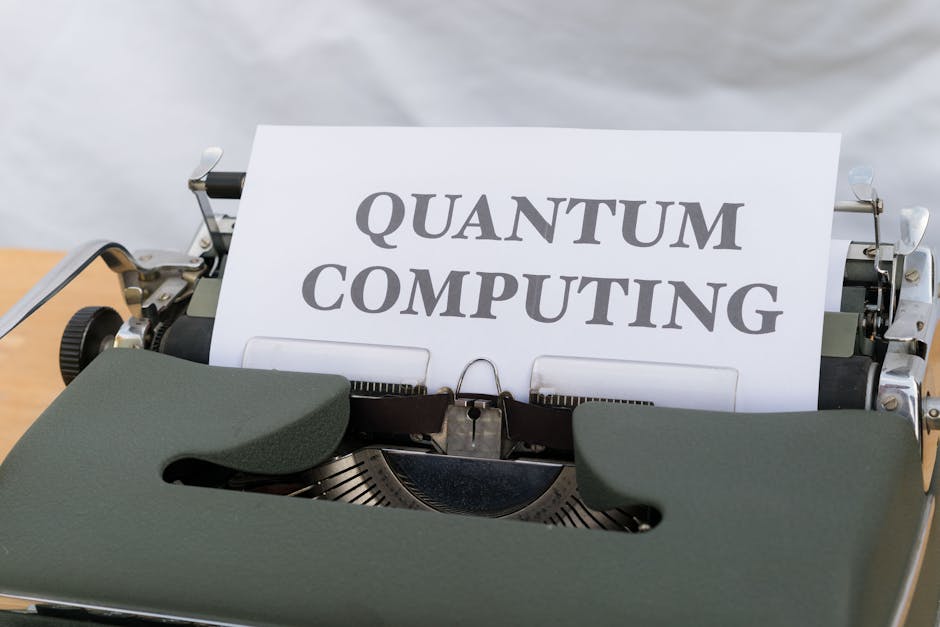
Quantum Computers: The Tech That Breaks Reality
You've got a lock. A good one. It would take a million years for a normal computer to try every combination. A quantum computer? It wouldn't even bother guessing. It would just walk through the door like the lock didn't exist. That's not a metaphor. That's the actual power of quantum computing—and it's coming for your encryption, your medicine, and your climate models.
Let's get one thing straight: quantum computers aren't just faster laptops. If regular computers are bicycles, quantum computers are teleportation. They don't work by flipping ones and zeros like a light switch. They work by exploiting a mind-bending property of the universe called superposition. In the quantum world, a particle can be in multiple states at once—spinning up and down, here and there, alive and dead like Schrödinger's cat. A quantum computer uses this to process millions of possibilities simultaneously. Where a normal chip checks one path at a time, a quantum chip checks every path at once and collapses into the right answer.
Think of it like this: You're trying to find the lowest point in a giant mountain range. A normal computer hikes every trail, one by one, measuring altitude. A quantum computer doesn't hike. It sends a wave over the entire landscape, and the answer emerges like a pattern in the interference. That's why these machines can crack encryption that would take longer than the age of the universe. That's why they can simulate a molecule's behavior exactly—not approximately—unlocking drugs for diseases we can't touch today. That's why Google's Sycamore processor performed a calculation in 200 seconds that would take a supercomputer 10,000 years.
But here's where the bullshit detectors should fire up. We're not all getting quantum laptops in our backpacks next year. These machines are finicky as hell. They need to be cooled to near absolute zero—colder than deep space—because any stray vibration or heat makes the quantum states collapse into random noise. The error rates are brutal. A quantum bit, or qubit, is about as stable as a soap bubble in a hurricane. So far, we've built machines that can do exactly one party trick—like the factoring problem or the random sampling thing—but not general-purpose computing. We're at the 1950s vacuum-tube stage, not the iPhone stage.
Still, don't sleep on this. The race is real. Google, IBM, and a bunch of startups are pouring billions into making qubits that don't break. China just built a quantum satellite that can beam entangled particles across continents. The moment we get error-corrected qubits—the moment these machines can run for more than a few seconds without crashing—the world changes. Your bank encryption? Obsolete. The lithium-ion battery in your phone? We'll design a better one in a day. The protein folding problem that stumps biologists for decades? Solved over lunch.
So here's the question that keeps me up: Who gets there first? Because the first nation or company to crack quantum supremacy doesn't just win the next tech cycle. They own the keys to every locked door on the planet. And the rest of us will be left standing outside, wondering how the hell they walked through.
💬 Comments