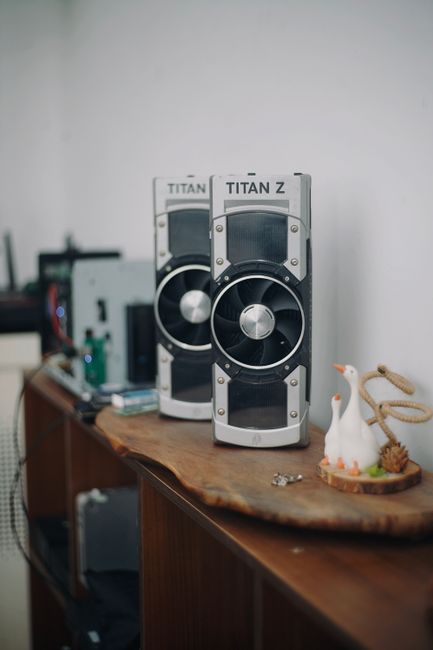
The Nvidia Rocket Is About to Blow Up
The trading floor at 4:15 PM. Guys in Patagonia vests staring at screens like they just saw their ex walk in with a new boyfriend. Nvidia's stock just hit another all-time high — up 200% in a year. Five trillion dollars in market cap. That's more than the entire GDP of the UK. And they're not selling phones or electric cars. They're selling computer chips — the kind that make ChatGPT go brrr. Everyone's rich on paper. But you know what happens when everyone's rich on paper? The paper gets wet.
Here's the thing nobody wants to say out loud: Nvidia is the only game in town for AI chips. Not Intel. Not AMD. Not some scrappy startup in Shenzhen. Jensen Huang's company owns 80% of the market. Every data center from Silicon Valley to Saudi Arabia is stacking Hopper and Blackwell GPUs like they're Jenga blocks. Amazon, Google, Microsoft — they're all begging Nvidia for allocations. It's like 2020 toilet paper, but each roll costs $30,000 and has to be replaced every two years. And the demand isn't slowing down. AI is eating the world. Every board meeting I've sat through in the past 18 months ends with some VP saying, "We need more compute." But here's the anxiety: what happens when a competitor shows up?
You think AMD is just going to roll over? Think again. Lisa Su's team is cooking something. And those custom chips that Google and Amazon are building — they're not for decoration. The moment a viable alternative hits the market, Nvidia's monopoly premium evaporates. And when that premium evaporates, so does the stock price. Because right now, Nvidia trades at 50 times earnings. That's not a company — that's a religion. Religions don't survive the first schism.
The real gut-punch is the geopolitical wire. Taiwan — where Nvidia's chips are fabricated — is a flashpoint that keeps every supply chain analyst awake at night. One misplaced warship in the Strait, and suddenly your $40,000 AI accelerator becomes a paperweight. The US government is already freaking out, throwing billions at domestic fabs. But those factories won't be online until 2027 at the earliest. Until then, Nvidia is a hostage to fortune and the weather in the Pacific. Ask me if I'm buying the dip. I'm not.
So you've got a stock priced for perfection, a market that's a single point of failure, a supply chain that could snap like a twig, and a product cycle that demands constant reinvestment. This isn't a growth story — it's a pressure cooker. The AI chip demand is real. The revenue is real. But the multiples? They're a bet that nothing goes wrong. And in my 20 years of watching markets, everything goes wrong eventually. The question is not if Nvidia's stock corrects. It's whether you're still holding when the music stops.
What keeps me up at night isn't Nvidia's earnings. It's the silence. I've never seen so many people agree on a trade. And consensus in markets is usually the signal to run for the exit. So enjoy the gains while they last. But keep one hand on the door.
💬 Comments