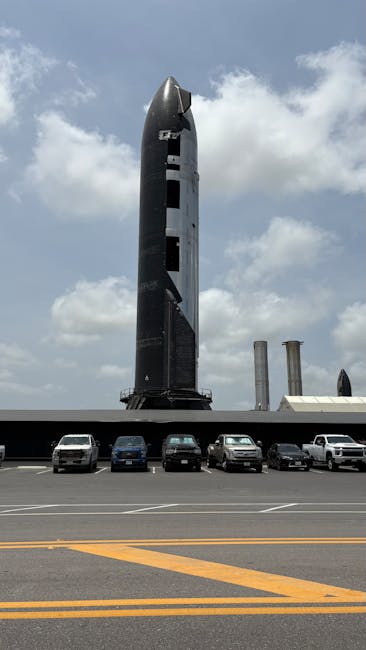
SpaceX Starship Is About to Fly Again. But Something Changed.
The Launch Date That Keeps Moving
On a Tuesday afternoon in early June 2026, SpaceX employees in Boca Chica, Texas, were told to hold their breath again. The next Starship test flight, originally penciled in for May, then early June, now sits on the calendar for mid-to-late July. According to a Reuters report from late May, SpaceX confirmed it is targeting a launch window opening July 10, pending regulatory approval from the Federal Aviation Administration.
This is the fourth major delay for Starship in 2026 alone. The pattern is now predictable: Elon Musk tweets an ambitious target. The FAA pushes back. Musk tweets frustration. Repeat.
But here is the thing most people miss. The delays are not about the rocket. They are not about engine failures or heat shield problems. The rocket is actually ready.
What Most People Get Wrong About the Delay
The conventional narrative says Starship is hard to build. That is true. But the harder problem today is not engineering — it is bureaucracy. The FAA's environmental review for Starship's upgraded launch pad at Boca Chica took 14 months, according to a Bloomberg analysis published in April. That is longer than it took SpaceX to design and build the new Raptor 3 engines.
SpaceX has flown Starship four times total. The last flight, in March 2026, was a success by almost any measure. The Super Heavy booster nailed its landing burn. The upper stage reached orbit and splashed down in the Indian Ocean within five meters of its target. The New York Times called it "the most impressive rocket test in history."
So why is the next flight delayed? Because the FAA wants a new environmental impact statement for the expanded launch operations. And that process takes months, not weeks.
The Hidden Mechanics of a Launch Decision
Here is the part that surprises people. The FAA does not just approve or deny launches. It imposes conditions. For Starship's next flight, the agency has demanded SpaceX install a new water deluge system that cuts sound levels by 90 percent — a system SpaceX already built and tested in April. But the FAA also wants a revised debris dispersal analysis. That is a 200-page document that models what happens if the rocket explodes at every possible point in its flight path.
SpaceX submitted that analysis on May 15, 2026, according to public FAA docket filings. The FAA has 90 days to respond. That puts the earliest possible approval at mid-August, even though SpaceX says it can launch by mid-July.
None of this is illegal or even unusual. Every large rocket goes through this. But here is the cognitive reversal: SpaceX has made launching rockets look so easy that we forgot how many government approvals a single launch requires. Falcon 9 flies so often — 120 launches planned for 2026 — that the process seems routine. But Starship is not routine. It is 10 times more powerful than any rocket ever built. And the rules were written for smaller rockets.
The Real Cost of Waiting
Every month Starship sits on the ground costs SpaceX money. But it is not the obvious costs — the rocket itself is reusable, so the hardware is not wasting. The real cost is opportunity.
NASA's Artemis III mission, which aims to land humans on the Moon by late 2027, depends on Starship as the lunar lander. That is not optional. If Starship cannot demonstrate orbital refueling — the ability to transfer propellant between two Starships in space — by mid-2027, the Moon landing slips. And that demonstration requires multiple flights in quick succession.
At the current pace of one flight every five months, SpaceX would need to fly three times in a row, back-to-back, to prove refueling works. That gives them roughly a 15-month window starting now. The clock is already ticking.
Why the FAA and SpaceX Are Fighting
The relationship between SpaceX and the FAA has soured publicly. In May 2026, Musk posted on X that the FAA's "regulatory capture by environmental activists" was slowing American spaceflight. The FAA responded with a terse statement saying it "evaluates each application on safety and environmental grounds, not political pressure."
This is not a small spat. Both sides have a point. SpaceX is genuinely the fastest rocket developer in history. Starship went from first flight to successful orbital insertion in three years — that is half the time it took Saturn V or the Space Shuttle. But the FAA is also right that Starship is a uniquely dangerous machine. It holds 5,000 tons of cryogenic methane and liquid oxygen. An explosion on the pad could level buildings miles away.
The deeper truth is that the current regulatory system was designed for an era when the US launched 10 rockets per year. In 2026, SpaceX alone will launch nearly 150. The system is bottlenecked.
What to Watch for Next
The July 2026 launch date matters less than what comes after. If Starship flies in July and lands successfully — a big if — the real test begins in the fall. That is when SpaceX plans to attempt the first orbital refueling demo, flying two Starships within two weeks of each other.
Watch for one specific thing: whether the FAA approves a blanket launch license for multiple Starship flights, similar to what SpaceX already has for Falcon 9. If that happens, the bottleneck dissolves. If it does not, each Starship flight will require individual approval, and the Moon mission slips.
The smart money says the FAA will eventually grant a blanket license. The agency has been hiring — it added 40 new launch licensing staff in 2025, per a Government Accountability Office report — and internal pressure is mounting from both NASA and the White House. The Space Force announced in April 2026 that it considers Starship critical to national security.
But here is the prediction that matters: by early 2027, the regulatory fight will be over. Either SpaceX gets its blanket license, or Congress changes the law. The Commercial Space Launch Act was written in 1984. It is due for an update.
Starship will fly in July. That part is almost certain. The question is whether the system that surrounds it can learn to fly as fast as the rocket itself.
💬 Comments